
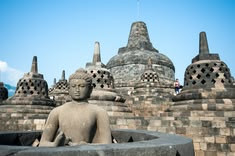
The Borobudur Buddha statues are among the most recognizable features of this historic Buddhist monument in Central Java. Hundreds of Buddha figures are positioned throughout its terraces, galleries, and stupas. Their placement, posture, and relationship with the surrounding architecture contribute to Borobudur’s religious and artistic significance.
Where Are the Buddha Statues Located?
Buddha statues can be found throughout various levels of Borobudur. Many are positioned inside niches along the square terraces, while others are enclosed within perforated stupas on the circular platforms.
This arrangement creates a visual progression as visitors climb the monument. The lower levels contain detailed reliefs and rows of statues, while the upper levels focus more strongly on stupas and open architectural spaces.
The statues are therefore not placed randomly. Their positions form part of the monument’s carefully organized design.
Buddha Statues in the Gallery Niches
On the square terraces, Buddha figures sit within recessed niches along the walls. Their repeated placement creates a rhythm throughout the galleries.
Visitors walking around the terraces can observe the statues from various angles. Each figure becomes part of the larger architectural composition, surrounded by carved stone and relief panels.
The combination of statues and reliefs creates a rich visual environment. The sculptures provide a three-dimensional element, while the reliefs cover the walls with narrative scenes.
Buddha Statues Inside the Stupas
The upper circular platforms contain another distinctive arrangement. Perforated stupas surround the central stupa, and Buddha statues can be seen through their openings.
The lattice-like stone design partially conceals the figures. This creates an interesting visual effect because visitors can see the Buddha statues without having direct access to them.
The relationship between the statues and stupas demonstrates how Borobudur combines sculpture with architecture. Neither element exists independently; both contribute to the monument’s overall design.
Various Buddha Postures and Symbolism
The Buddha figures at Borobudur are traditionally associated with different mudras, or symbolic hand gestures. These gestures have religious meanings within Buddhist traditions.
The arrangement of the statues and their gestures are connected with the monument’s symbolic organization. As visitors progress through the various levels, the architectural environment changes alongside the placement and presentation of the Buddha figures.
For travelers who want to understand how the statues fit into Borobudur’s wider design, this Borobudur inside guide provides additional information about its structure, reliefs, and spiritual meaning.
The Relationship Between Statues and Architecture
The Borobudur Buddha statues are an essential part of the monument’s architectural balance. Rows of figures create visual consistency along the galleries, while the statues inside the upper stupas introduce a various pattern.
The contrast between enclosed and open spaces is particularly noticeable. Lower statues are clearly visible within wall niches, while upper Buddha figures appear through the perforations of surrounding stupas.
This changing presentation reinforces the transition from the square terraces to the circular platforms.
Appreciating the Statues During a Visit
Visitors can gain more from Borobudur by taking time to observe individual Buddha figures rather than viewing them only as part of the overall monument.
Pay attention to their posture, hand gestures, position within the architecture, and relationship with nearby reliefs. These details help reveal the artistic planning behind the monument.
Photography can also highlight various in perspective. From the upper platforms, the repeated stupas and statues create a distinctive geometric composition.
Explore Borobudur’s Buddhist Heritage
The Borobudur Buddha statues demonstrate how sculpture, architecture, and religious symbolism were brought together in one monumental design. Their placement throughout the terraces and stupas creates a visual journey that complements the monument’s broader spiritual concept.
Travelers interested in exploring Borobudur and other cultural destinations in Central Java can explore more through Borobudur Tours.
By looking closely at the Buddha figures and their surroundings, visitors can better appreciate the artistic details that make Borobudur one of the most remarkable Buddhist monuments in Southeast Asia.